As development speed and abstraction accelerate, traditional testing approaches can't keep up. This leaves organizations unsure if their applications are doing what's intended or missing what's required. Application integrity offers the continuous, measurable assurance that your software just works as intended – with governance to operate at AI speed and scale.
The backstory
AI is fundamentally reshaping how applications are built. Your organization may span traditional human-led development, human + AI (AI-augmented), and fully autonomous systems – and we often see multiple variations in a single organization, as needs vary by product line or business unit. This shift in application development is real and immediate, transforming how fast code is developed, how much is created, and how your teams interact with it.
AI accelerates development, but it also introduces new challenges. How do you validate what's being built? How do you ensure outcomes align with intent? Practitioners and executives alike are asking:
How can we ensure the integrity of 10x more applications developed at 10x speed?
Legacy testing models can't scale to match this reality, and code-level validation is insufficient to validate user experience. As application volume and velocity outpace existing controls, the limits of conventional testing become clear. Teams that once maintained quality through established practices now struggle to keep pace with AI-driven development.
This is where application integrity becomes essential. It provides the framework, tools, and governance you need to maintain confidence in software quality as development velocity increases exponentially.
For organizations navigating this transition, application integrity offers an immediate path forward – one that embraces AI-accelerated development while delivering the trust and reliability your users, customers, and stakeholders demand.
Why application integrity matters
As applications are increasingly built by a combination of human developers, AI-assisted coding tools, and autonomous agents, application integrity shifts the conversation from traditional code-level validation to a fundamentally different question:
Does the application consistently deliver the intended user experience outcome?
Unlike conventional best practices focused on code compilation or unit tests, application integrity delivers confidence across the full software development lifecycle:
- API design and governance
- Functional testing
- Load and performance validation
- Test management
- Application observability
It meets the demands of modern development where specifications may be incomplete or abstract, and where testing strategies must match the velocity and complexity of AI-influenced development.
What problems does application integrity solve?
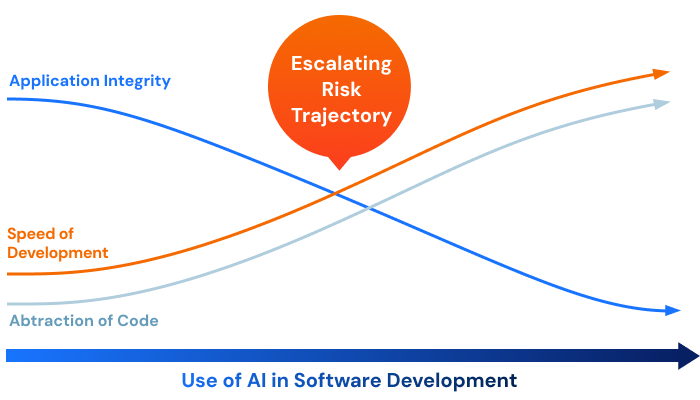
In the pre-AI era, many companies were anchored in legacy linear processes that inhibited the ability to radically change the SDLC. Now, in the AI era, two critical new vectors are making this challenge exponentially more difficult:
Speed adds chaos
AI-assisted development increases the rate and volume of code production. It also creates a growing gap between the velocity of software being built and your ability to verify you've built the right thing and validate that it does what it's intended to do. When AI can generate applications in minutes instead of months, traditional testing cycles are now outpaced. Teams find themselves in constant catch-up, unable to verify they've built the right application or validate its functionality at the speed that it's being created.
This requires fundamentally rethinking how verification and validation happen. Application integrity enables ongoing, automated verification and validation that operates at AI speed – testing that keeps pace with development rather than slowing it down.
And AI doesn't just accelerate testing – it reshapes the entire software delivery system. Code generation, validation, governance, and runtime behavior now happen continuously, instead of in isolated phases. Application integrity unifies these into a single system that ensures what's built aligns with intent at every stage.
As APIs evolve faster, application integrity enforces governance by maintaining design standards, documentation, and visibility, preventing API drift and breaking changes.
Observability closes the loop by validating real-world behavior in production and surfacing regressions, anomalies, and documentation gaps as they emerge.
Abstraction obfuscates clarity
As development becomes more autonomous, teams increasingly rely on agents to create code based on simple, natural language prompts – or grant them autonomy to determine implementation independently. The traditional model of detailed upfront requirements is giving way to a new reality: you often learn what's been delivered after the fact.
This creates a gap between what's built and what can be articulated. When specifications are incomplete or abstract, how do you validate applications meet requirements? How do you ensure AI-generated code aligns with business intent when that intent wasn't fully documented?
Application integrity solves this through intent awareness – clarifying and validating intended outcomes even in the face of inadequate formal specifications. By maintaining a discoverable single source of truth, you can bridge the gap between intent and implementation, ensuring applications deliver expected business value regardless of how they were created.
The integrity collapse
The bottom line is stark: legacy software development simply cannot keep up with these two new vectors, exacerbating and escalating risk for organizations. If you apply AI to a broken system, you're only amplifying that broken system; you're not fixing it at its core. It's time to throw out the old playbook and pivot to a new way of application development.
In addition to being developed differently, applications are being consumed differently too – they're built not just for humans but also for agents acting as end users. More speed risks more chaos, and the lack of a single source of truth means AI and autonomous coding often operate as a black box with no system of record.
Achieving application integrity provides the answer: a unified approach to validation, governance, and confidence that scales with AI development, maintains visibility into what's being built, and ensures that software delivers on its intended purpose – no matter how fast the landscape changes.
How to realize application integrity
Establishing application integrity doesn't have to be an all-or-nothing transformation. You can progress incrementally, meeting your organization where it is today while building toward greater autonomy and scale.
Start where you are
Application integrity begins with creating a unified quality system of record that captures what's being built, how it's being tested, and where risks could appear. This foundation enables everything that follows.
Progress through stages
As your AI adoption matures, your approach to application integrity evolves:
Early adoption focuses on visibility and governance. You're learning where friction exists in your pipeline and where you have opportunity to adopt AI and establish controls around pilot projects. Building a framework to monitor AI behavior to build confidence in early experiments is foundational in attaining application integrity.
Scaling requires integrated validation across teams and pipelines. As AI-assisted development expands, application integrity ensures continuous testing keeps pace with increased velocity, validating at AI speed without becoming a bottleneck.
Optimization shifts toward autonomous validation. Testing strategies adapt in real time, feedback loops tighten, and validation happens continuously with minimal human intervention.
Match validation to autonomy
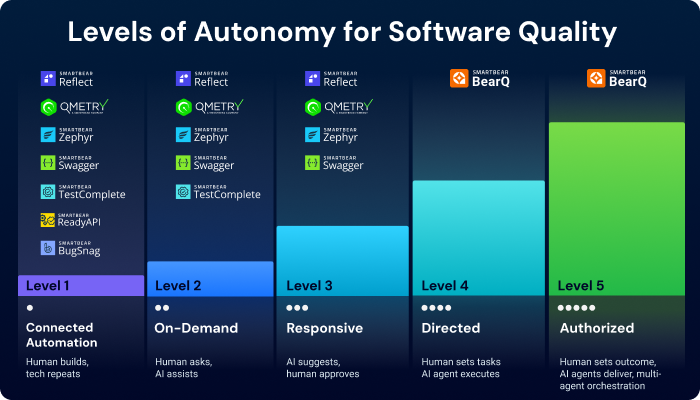
How you validate your approach to application integrity should align with your level of AI autonomy. This means the requirements for application integrity depend on the level of autonomy for each of your applications:
- Level 1 – Connected automation: Start with human-built test scripts and workflows that technology executes reliably.
- Level 2 – On-demand: Use AI to generate test cases, analyze failures, and assist with accelerating routine tasks while you maintain control.
- Level 3 – Responsive: Proactive guidance to let AI surface risks, propose tests, and recommend fixes while you make final decisions.
- Level 4 – Directed: Set the task and let agents handle test creation, execution, and initial analysis end-to-end.
- Level 5 – Authorized: Autonomous delivery where you define desired outcomes and let multi-agent systems determine how to achieve them, handling the full testing lifecycle.
Build trust at every step
Regardless of where you start or where you're heading, application integrity ensures you can answer the critical question: Does this application consistently deliver the intended outcome?
SmartBear meets you where you are, helps you establish the foundation you need, and enables you to progress with quality and confidence baked into every step of your AI journey.
The Application Integrity Core™
Everything we build centers around our Application Integrity Core – a comprehensive foundation upon which we've built a holistic suite of solutions that ensure quality, governance, and trust across every stage of the software lifecycle:
- API lifecycle management ensures your APIs are well-designed, properly documented, and governed from conception through retirement.
- Testing capabilities cover functional testing, load and performance validation, and test management – giving you the flexibility to validate any application scenario.
- Application observability provides real-time visibility into how your software performs in production, closing the loop between testing and operational reality.
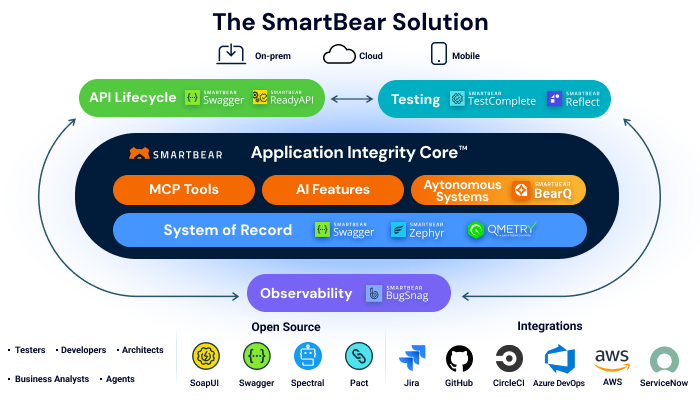
These capabilities are seamlessly connected, so quality insights flow across your entire delivery process. When an API changes, your tests update. When production issues emerge, they inform your testing strategy. Everything synchronizes.
The SmartBear Application Integrity Core meets you wherever your applications are – on-premises, in the cloud, or on mobile devices – and it serves your entire organization: testers, developers, architects, and increasingly, AI agents and beyond. Each role gets the tools and visibility they need, while everyone works from the same quality foundation.
This unified approach is what positions SmartBear uniquely for the future of intelligent application delivery. As development becomes more autonomous and velocity continues to increase, you'll have a quality system that scales with you – earning and strengthening trust, visibility, and control, however you build your software.
Your path forward
Traditional approaches can't validate 10x more applications developed at 10x speed. The SmartBear Application Integrity Core can.
It shifts the conversation from "Does the code work?" to "Does the application consistently deliver the intended outcome?" It provides continuous, measurable assurance that your software just works – with the governance to operate at AI speed and scale.
And it fits naturally into what you already use. We integrate across your software development lifecycle, from planning and design through development, testing, deployment, and production monitoring. You don't reinvent your toolchain. You enhance it.
This is the new bar for software quality in the AI era.
See application integrity in action